Hiring DevOps Engineers in Europe - 2026 Market Guide
Where the senior DevOps bench sits in Europe in 2026, what it costs, and what to ask in the interview.
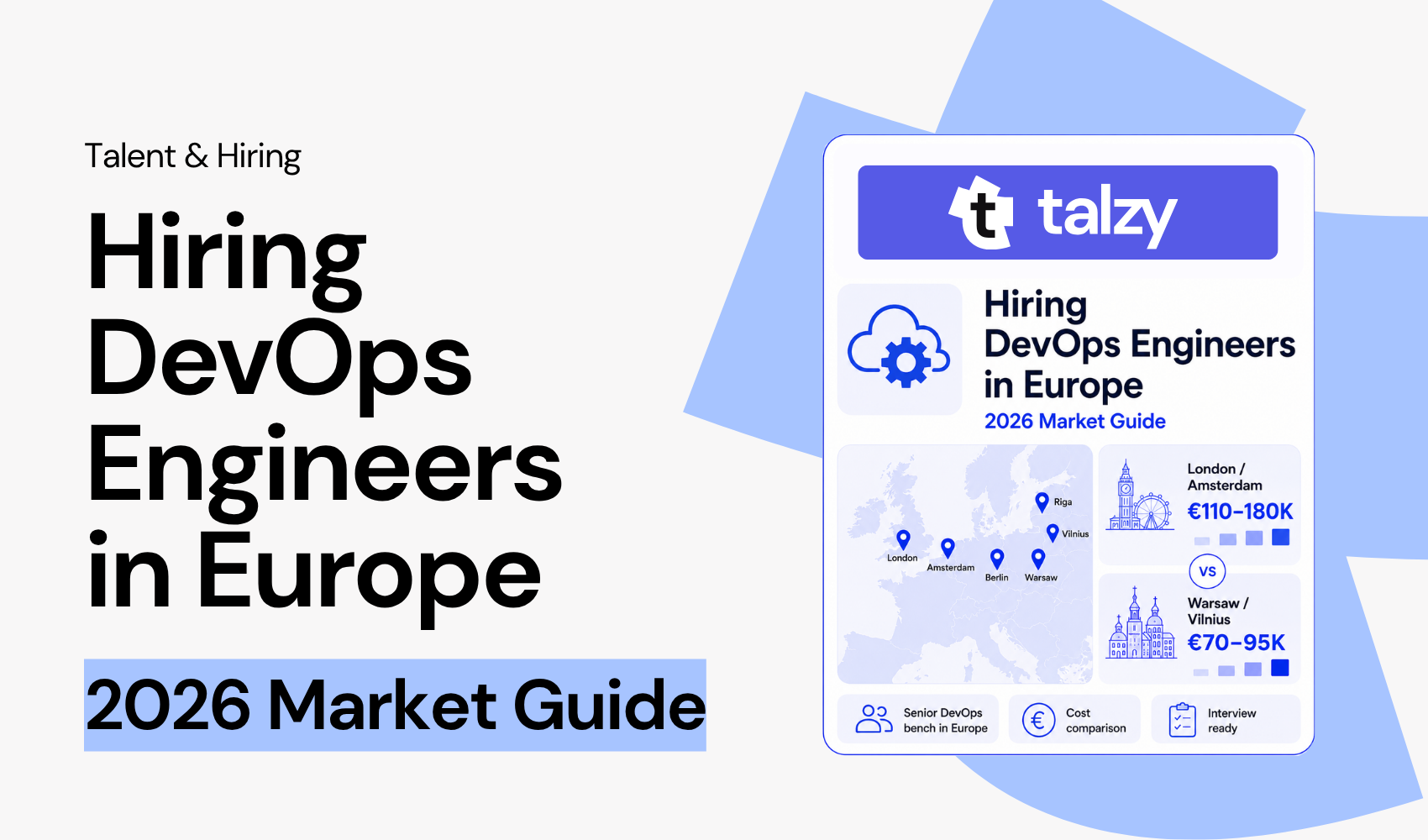
A senior DevOps engineer in Europe in 2026 costs €110–180K/year fully loaded in London or Amsterdam, vs €65–95K in CEE - same skill, half the cost, with deep benches in Warsaw and Vilnius and the strongest Azure and hybrid cloud DevOps pool in Riga.
Hiring DevOps Engineers in Europe - 2026 Market Guide
A senior DevOps engineer in London or Amsterdam costs €110–180K/year fully loaded in 2026. The same engineer - same stack, same seniority, same ability to own a production incident at 2am - costs €70–95K/year in Warsaw or Vilnius. That gap has not narrowed in 2025 or 2026; if anything, it has widened as Western European tech hiring has slowed while CEE senior talent pools have continued to deepen. If you are looking to hire DevOps engineers for a growth-stage team, this guide covers where the bench sits, what the cost looks like city by city, and what the interview process needs to include to tell a real platform engineer from someone with "DevOps" in their title.
DevOps vs SRE vs Platform Engineer - what you are actually hiring for
The three titles are used interchangeably in job posts and almost never mean the same thing in practice. Getting this wrong before the search starts costs 6–8 weeks and a bad hire. Here is how we define each for the purpose of a hiring brief:
DevOps engineer - the broadest definition. In most growth-stage companies, a "DevOps engineer" owns CI/CD pipelines, cloud infrastructure (AWS/GCP/Azure), deployment automation, and the intersection between how developers write code and how that code runs in production. The role is heavily Terraform, Kubernetes, and observability tooling. It is a generalist infrastructure role that scales well in teams of 10– 50 engineers where a dedicated SRE function would be premature.
Site Reliability Engineer (SRE) - the Google-origin definition, now widely adopted. SREs are engineers first, operations second - they write production code to automate reliability, hold explicit error budgets, and are expected to push back on product teams when service level objectives are at risk. A true SRE at a Series B company is a rare hire; most companies posting "SRE" are actually describing a senior DevOps engineer with stronger on-call ownership. If the role does not have an explicit SLO framework and engineering time allocation, it is not an SRE role regardless of the title.
Platform Engineer - the most specialised of the three. Platform engineers build internal developer-experience products: golden-path CI/CD templates, internal developer portals (IDPs), Kubernetes platforms with guardrails, and the tooling that lets product engineers deploy without becoming infrastructure experts themselves. This role is premature before you have 30+ engineers and a clear DX bottleneck. Hiring a platform engineer when you need a DevOps engineer is expensive and demoralising for both parties.
In practice: define the day-to-day before posting. What does this person own in the first 90 days? What is the incident response expectation? What does their week look like? That description determines which of the three profiles you actually need - and which interview signals to look for.
Where the senior DevOps bench sits in Europe (2026)
Volume and quality are not the same variable. Here is an honest read on both across the six markets we track most closely:
London - the largest absolute pool in Europe. High volume, genuinely deep seniority across AWS, GCP, and Azure. The cost ceiling is also the highest. London DevOps engineers are accustomed to competitive offers from scale-ups and financial services, and the market moves fast. If you need to hire at pace and cost is secondary, London has the bench. If you are building a team over 12 months with budget discipline, it is the hardest market to operate in without overpaying.
Amsterdam - smaller than London but a strong senior pool, particularly for cloud-native and Kubernetes-heavy roles. The Amsterdam market has significant fintech and e-commerce concentration, which means engineers with high-traffic production experience are plentiful. Cost is marginally lower than London but still in the Western European bracket - €130–170K/year fully loaded for a senior engineer.
Berlin - deep pool, lower cost than London and Amsterdam, strong DevOps culture built on the back of a decade of Berlin startup ecosystems. Berlin DevOps engineers tend to be strong on open-source tooling (Prometheus, OpenTelemetry, Helm) and less concentrated in proprietary cloud-managed services than London. The pool skews toward AWS and GCP.
Warsaw - the strongest CEE DevOps market by volume. Deep bench in Kubernetes, Terraform, and AWS. Warsaw has benefited from a significant wave of Western European companies building engineering hubs there since 2020, which means senior engineers have production exposure at scale. Cost: €75–95K/year fully loaded for a senior. If you are hiring across both DevOps and backend simultaneously, Warsaw is the most operationally efficient single city in CEE.
Vilnius - the strongest CEE market by quality per capita, in our observation. Vilnius DevOps engineers disproportionately come from fintech and security-gradeinfrastructure backgrounds - Nord Security, Vinted, Revolut's Lithuanian operations, and Nasdaq's Vilnius engineering office have produced a cohort of senior engineers with production experience most London companies would pay significantly more for. Cost: €70–88K/year fully loaded. Narrower pool than Warsaw but higher average seniority at the senior+ level.
Riga - smaller pool than Warsaw or Vilnius, but meaningfully stronger than its size suggests. Riga’s DevOps bench has been shaped by a deep enterprise software heritage - many of Latvia’s longest-established tech companies run Microsoft-heavy infrastructure, which has produced a strong cohort of Azure, .NET-adjacent DevOps, and hybrid cloud engineers that is difficult to find at this depth anywhere else in CEE. The city also benefits from the same retention dynamics we see across Latvian placements: churn among Riga-based engineers consistently runs below the CEE average, which matters when you are building a team you plan to keep. Cost: €65–85K/year fully loaded - the most competitive of the six markets. Best used when your stack skews Azure or hybrid cloud, when retention matters more than raw pool volume, or as the third CEE option alongside Warsaw and Vilnius for teams building across multiple markets.
2026 cost - fully loaded
The table below shows fully loaded annual cost: gross salary plus employer social contributions plus workspace and equipment. It does not include recruitment cost or ramp-up time, both of which add materially to the first-year total. For the full cost methodology, see the 2026 developer cost guide.
| CITY | MID (3–5 YRS) | SENIOR (5–8 YRS) | STAFF / LEAD (8+ YRS) |
| London | €85–110K | €120–160K | €160–210K |
| Amsterdam | €90–115K | €130–170K | €170–220K |
| Berlin | €70–90K | €100–135K | €135–175K |
| Warsaw | €55–70K | €75–95K | €95–125K |
| Vilnius | €52–66K | €70–88K | €88–118K |
| Riga | €48–62K | €65–85K | €82–110K |
A few things this table does not capture: the Lithuania employer contribution quirk that makes Vilnius cheaper than the gross salary comparison suggests (employer-side Sodra is ~1.8% versus Latvia's ~23.6% and Poland's ~19.2%), and the Warsaw vs regional Poland gap (~15–20% cheaper outside Warsaw for comparable seniority). For a deeper breakdown of how employer contributions affect the real cost in each CEE country, the senior engineer cost in 2026 comparison covers this in detail. For current, role-specific numbers updated from live placements, see Talzy pricing.
Four signals to look for in the interview
Most DevOps interview processes over-index on tool knowledge and under-index on operational judgment. A candidate who can recite Kubernetes RBAC rules but has never owned a production incident is not a senior DevOps engineer - they are a mid-level engineer with a broad reading list. Here are four signals that actually separate senior from not-yet-senior:
Signal 1: They can name the runbook for their last incident. Ask them to walk you through the most significant production incident they owned in the last 18 months. A senior engineer can name the runbook, describe what the alert fired on, what the first three diagnostic steps were, and what the post-mortem changed. An engineer who gives a vague answer about "a database issue" and cannot describe the mitigation sequence has not owned incidents at the level the title claims. Operational memory is a senior signal.
Signal 2: They have owned a cost line. Cloud cost optimization is not just an infrastructure task - it is a judgment call that involves understanding business priorities, engineering trade-offs, and stakeholder communication. Ask: "Have you ever owned a cloud cost reduction initiative? What did you find, what did you change, and what was the result?" An engineer who has done this will have a specific answer with numbers. An engineer who has not will give a generalized answer about right-sizing. This is one of the clearest seniority signals in DevOps specifically, because it requires both technical depth and business context.
Signal 3: They can articulate why their team chose Terraform over CDK or Pulumi - or why they did not. Tool choice in infrastructure is a decisions-under- constraints problem, not a best-practices recitation. Ask: "What IaC tooling does your current team use, and what was the reasoning at the time it was chosen? Would you make the same call today?" A senior engineer will describe the trade-offs (HCL vs general-purpose language, state management, team familiarity, CDK's CloudFormation ceiling) and have an opinion shaped by production experience. An engineer who gives a vendor-neutral non-answer or defaults to "it depends" without specifics is not operating at senior level.
Signal 4: They have a formed opinion on observability tooling. Ask: "Your team is evaluating Datadog vs a self-hosted Prometheus/Grafana/OpenTelemetry stack. What would you want to know before making a recommendation?" A senior engineer will discuss cost curve at scale, cardinality limits, team operational overhead, vendor lock-in, and the difference between metrics, logs, and traces as data types. An engineer who defaults to "Datadog is great" or "open source is always better" without engaging the trade-offs has not designed an observability stack from scratch.
These four signals can be assessed in a single 90-minute structured interview. A take-home infrastructure design exercise (build a CI/CD pipeline for a given scenario, document the decisions) adds a code-under-real-conditions dimension that the interview alone cannot replicate.
The hidden cost of "consultant" DevOps engagements
DevOps consulting is a legitimate market segment and there are scenarios where it is the right call. But the total cost of a consultant engagement is consistently underestimated at the outset - because the headline day rate is not the number you will pay.
The mechanics are straightforward. A DevOps consultant billing at €800–€1,200/day in London or Amsterdam runs at €168,000-€252,000/year on a 210-day working year. That number alone puts the engagement in the same bracket as two CEE in-house engineers. But the real cost is higher still - because it does not include the knowledge-transfer overhead when the engagement ends.
A consultant engagement that runs 9 months and requires a 3-week handover to an in-house hire typically costs 15–20% more than the headline day rate alone suggests. Decisions made without documentation become the next hire's first 3 weeks of work.
When consultants are genuinely the right choice, the engagement has a hard end date and a defined deliverable: a cloud migration, a SOC 2 Type II infrastructure audit, a one-time Kubernetes platform build. The moment the scope shifts from "build this thing" to "own this thing," the model stops making sense economically.
The 12-month comparison against a CEE in-house hire is stark:
| LONDON CONSULTANT | CEE IN-HOUSE (VILNIUS) | |
| Day rate / annual | €800-1200/day · €168-252k/yr | - |
| Fully loaded annual | ~€210K (midpoint) | €70–88K |
| Institutional context at 12 months | Leaves with the engineer | Stays with your team |
| Handover cost | 2–4 weeks of next hire's time | None |
For ongoing platform ownership - the role that most "DevOps consultant" engagements quietly morph into over time - in-house wins at the 6-month horizon and beyond, on both cost and knowledge retention. The four ways to hire from Eastern Europe covers the full model trade-offs in more detail.
Hiring DevOps through Talzy
Our DevOps placement process runs 2-4 weeks from kickoff to signed offer for a senior role - longer for narrow or compliance-heavy stacks (FedRAMP-aligned infrastructure, OT/ICS environments). Here is how it works:
• Markets: Warsaw, Vilnius, and Riga. Each market has its own strength - Warsaw for volume and AWS/GCP depth, Vilnius for fintech-grade senior quality, Riga for Azure, hybrid cloud, and Microsoft-stack teams. We search across all three by default and recommend a city mix based on your stack and timeline.
• Vetting sequence: CV and portfolio screen via the Talzy platform → 30-minute call with the candidate (your framework or one we provide) → infrastructure design exercise scoped to your stack and scenario → reference calls, minimum two from direct managers or senior peers.
• Shortlist standard: We typically present 2–3 shortlisted candidates before you make a hire decision.
Recent placement - anonymized: A Series B fintech needed a senior platform engineer to own a Kubernetes migration on GKE and build the CI/CD golden path for a team of 22 engineers. We searched across Warsaw and Vilnius over 6 weeks, screened 14 candidates, ran 3 through final trial. Placed: a Vilnius-based engineer, Nord Security background, 9 years total experience, strong Terraform and ArgoCD, prior cost- optimization ownership at comparable scale. Fully loaded cost: €82K/year. Equivalent profile in London: €145–165K/year.
The starting point is a 30-minute kickoff call to define the role, the stack, the team structure, and what you need from the shortlist. Start a conversation and we will tell you honestly whether the profile you need is hireable in our pool in your timeline - including if the answer is not yet.
If you are also building out the broader engineering team alongside DevOps, the senior backend developers in CEE guide covers the backend hiring picture in the same three markets.
Frequently asked questions
Evaluating how to build your European team?
Tell us the role and team size. We'll send an honest read on whether Talzy is the right partner - and if it is not, we'll tell you that too.